Your Body Has a Breakfast Clock — Here's How to Work With It Instead of Against It
For years, the breakfast advice was pretty simple: eat within 30 minutes of waking up, no excuses. Grab something, anything, and get moving. But if you've ever forced down a bowl of oatmeal at 6:30 AM while your stomach was still basically asleep, you already know that rule doesn't work for everyone.
Here's the thing — science is starting to catch up with what your body has been quietly telling you all along. The idea of a universal breakfast window is giving way to something a lot more nuanced and honestly, a lot more interesting.
What Is a Chronotype, and Why Should You Care?
Your chronotype is essentially your biological blueprint for sleep and wakefulness. It's why some people spring out of bed at dawn feeling like they can conquer anything, while others don't hit their stride until mid-morning. These aren't personality quirks or laziness — they're rooted in genetics, age, and the internal circadian rhythms that govern nearly every system in your body.
Researchers at institutions like the Salk Institute and the University of California San Diego have spent years studying how circadian biology interacts with eating patterns. What they've found is striking: your digestive system, metabolism, and even your brain's glucose uptake don't just flip on the moment you open your eyes. They wake up on their own schedule, and that schedule varies significantly from person to person.
Forcing food in before your body is metabolically ready can actually blunt the very benefits you're hoping to get from a good breakfast — steady energy, mental clarity, a stable mood. You're essentially trying to run software before the operating system has finished loading.
The Two-Hour Window That Actually Makes Sense
So where does the two-hour window come in? Research suggests that eating your first meal within roughly two hours of waking — once your cortisol levels have naturally peaked and begun their morning decline — tends to align best with your body's metabolic readiness. That cortisol spike right after waking, sometimes called the Cortisol Awakening Response (CAR), is your body's natural alarm system. It mobilizes energy, sharpens alertness, and primes your digestive system.
The sweet spot for most people sits somewhere between 30 minutes and two hours post-waking. But here's the key: that window should be anchored to your wake time, not a societal standard. An early riser who's up at 5:30 AM and a night owl who rolls out of bed at 9:00 AM are both working with the same two-hour principle — they're just running on different clocks.
Eating too early (before that cortisol peak has done its job) or waiting too long (past the two-hour mark, when blood sugar starts to dip and stress hormones begin to creep back up) can leave you foggy, irritable, or ravenous by mid-morning.
If You're an Early Riser
Good news — your chronotype tends to align most naturally with conventional breakfast timing. If you're waking up between 5 and 7 AM, your cortisol peak typically hits fast, and your body is ready for fuel sooner rather than later.
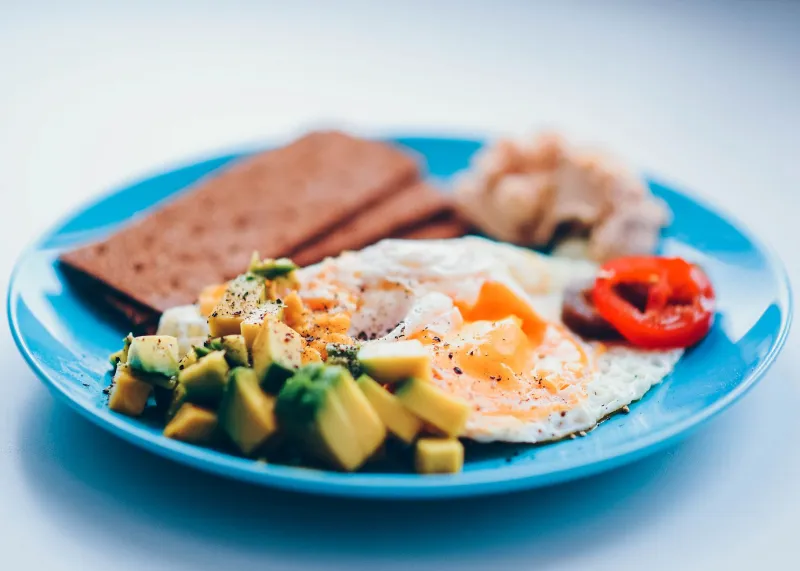
The practical move here is to lean into a real, substantial breakfast in that first hour. Think protein, healthy fats, and complex carbs — eggs with whole grain toast, a smoothie with Greek yogurt and nut butter, or even savory oats with a soft-boiled egg. Your metabolism is primed and your brain is hungry. Feed it well and you'll feel the difference by 10 AM.
One thing early risers sometimes get wrong: eating too lightly because it's early and the appetite feels modest. A small, rushed breakfast might technically check the box, but it won't sustain you through a demanding morning the way a more complete meal will.
If You're a Night Owl
This is where the advice gets more liberating. If you're naturally wired to wake up at 8, 9, or even 10 AM, there's zero biological reason to force breakfast at 7. Doing so — especially on weekends or days off — can actually work against your body's rhythms rather than with them.
For night owls, the two-hour window still applies, but it starts when you actually wake up, not when the rest of the world says you should. If you're up at 9 AM, aim to eat your first real meal by 10:30 or 11. That's not brunch — that's just well-timed breakfast.
The challenge for night owls in a 9-to-5 world is the weekday-weekend mismatch, sometimes called social jet lag. If you're forcing yourself up at 6:30 AM for work but your body wants to sleep until 9, try keeping your breakfast window consistent even on early days — eat something small within two hours of your forced wake time, even if appetite is low. A protein-forward option like cottage cheese with fruit or a hard-boiled egg tends to sit easier than heavy carbs when your gut isn't fully online yet.
What About Shift Workers?
Shift workers face a genuinely complicated relationship with breakfast because their wake times rotate and their circadian rhythms can take a real beating. For anyone working nights, rotating shifts, or highly irregular hours, the two-hour principle still holds — but "breakfast" becomes less about the clock and more about the context of waking.
If you've just come off a night shift and you're waking up at 2 PM, your body's cortisol awakening response is still happening — just at 2 PM. That's your breakfast window. Trying to eat "breakfast" at 8 AM before a night shift because it feels normal can actually disrupt your metabolic rhythm further.
Shift workers often benefit from thinking of their first meal after sleep as breakfast regardless of what time it falls, and prioritizing protein and fiber to stabilize blood sugar through what will likely be an unconventional day.
A Few Practical Ways to Find Your Window
Not sure where your natural rhythm lands? Here are a few ways to dial it in:
- Track your hunger for a week. After waking, note when you first feel genuinely hungry (not just habitual hunger or coffee cravings). That signal is your body's way of saying it's metabolically ready.
- Notice your 10 AM energy. If you're consistently crashing or craving sugar mid-morning, you may be eating too late, too little, or the wrong balance of macros for your timing.
- Experiment on a day off. Without alarm clocks or social obligations, wake naturally and notice when appetite shows up. That's closer to your true chronotype window.
- Keep it consistent. Circadian rhythms thrive on regularity. Even if your window is 9–11 AM, keeping that consistent on weekdays and weekends helps your metabolism stay predictable and efficient.
The Bottom Line
Breakfast isn't a one-size-fits-all event, and the most brilliant morning meal is the one that actually works with your biology. The two-hour window after waking isn't a rigid rule — it's a framework that gives your body the metabolic head start it's already primed to receive, on its own terms.
Whether you're an early riser crushing a full spread by 6 AM or a night owl finally sitting down to eggs at 10:30, the goal is the same: eat when your body is ready, eat something worth eating, and let that meal do the work it's designed to do. The rest of your day will thank you.