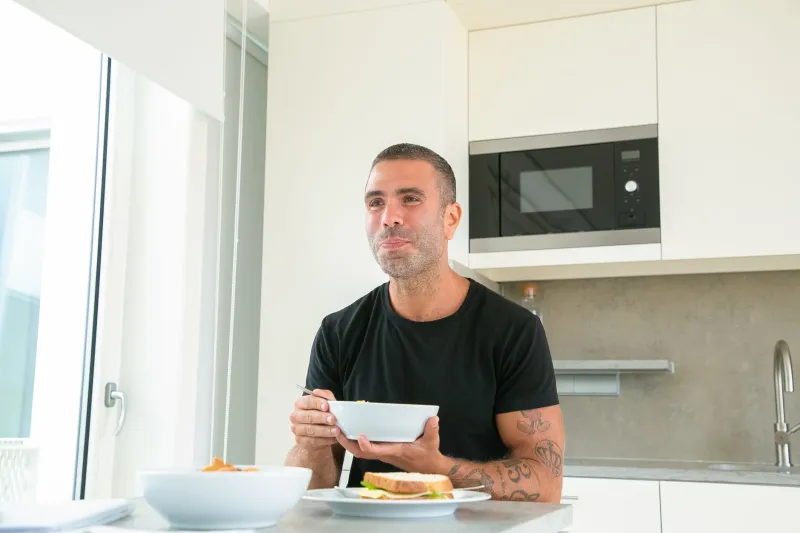
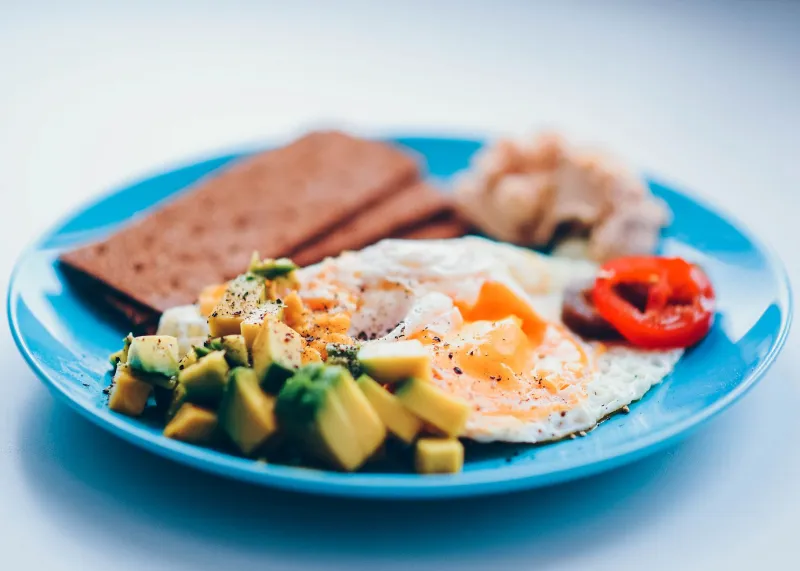
Slow Down to Feel Full: The Counterintuitive Breakfast Habit That Changes Everything
Most of us have spent years obsessing over the what of breakfast. Protein or carbs? Eggs or oatmeal? Whole grain or gluten-free? But there's a dimension of your morning meal that rarely gets any airtime — and it might matter just as much as anything you put on your plate.
How fast you eat.
It sounds almost too simple to be real. But the science behind eating speed is legitimately fascinating, and the implications for how you feel, think, and perform all day are hard to ignore.
Your Brain Is Always Running a Little Behind
Here's the core problem: your gut and your brain don't communicate in real time. After you start eating, it takes roughly 15 to 20 minutes for satiety signals — primarily from hormones like leptin, GLP-1, and cholecystokinin — to travel from your digestive system up to your hypothalamus, where the "I'm full" message actually registers.
If you inhale your breakfast in six minutes (and honestly, a lot of us do), you've already finished eating before your brain has had any chance to catch up. Your body is processing food, hormones are starting to fire, but the signal arrives late to an empty table.
The result? You don't feel satisfied. You go looking for more. And by the time 10 AM rolls around, you're raiding the office snack drawer wondering why your "good breakfast" didn't hold you.
This isn't a willpower issue. It's a timing issue.
What Happens When You Deliberately Slow Down
Researchers have been poking at this question for years, and the findings are pretty consistent. Studies published in journals like Appetite and the American Journal of Clinical Nutrition have found that people who eat at a slower pace consume fewer calories overall — not because they're trying to, but because their fullness signals have time to kick in before they've overeaten.
More interestingly for our purposes: participants who slowed their eating rate reported feeling more satisfied after meals, even when the portion size was identical to what faster eaters consumed. Same food. Same calories. More fullness. Just because of pace.
That's the paradox. Eating slower doesn't just help you eat less — it actually makes your brain perceive the meal as more substantial. You're essentially getting more satiety out of the same breakfast.
The Chewing Factor Nobody Talks About
One of the underrated mechanics here is chewing. When you chew more thoroughly, a few things happen simultaneously. You break food down into smaller particles, which increases the surface area available for digestive enzymes — meaning your body extracts nutrients more efficiently. You also slow the physical pace of eating, which gives those hormonal signals more time to get moving.
But there's another layer: chewing triggers cephalic phase digestive responses, which is a fancy way of saying your body starts preparing for digestion the moment you begin eating. Saliva production ramps up. Stomach acid increases. The whole system primes itself. When you eat too fast, you short-circuit some of this preparation, and digestion becomes less efficient.
Try this as a starting experiment: count your chews on the first few bites of breakfast tomorrow. Most people chew somewhere between 5 and 10 times before swallowing. Aim for 20 to 25. It feels weird at first — almost performatively slow — but within a few days, it starts to feel normal.
A Practical Timing Experiment Worth Trying
If you want to actually test this on yourself, here's a simple protocol to run over two weeks.
Week one: Eat breakfast at your normal pace. Don't change anything else. About 90 minutes after finishing, rate your hunger on a scale of 1 to 10 and jot it down.
Week two: Eat the exact same breakfast, but set a timer for 15 minutes and don't finish before it goes off. Put your fork down between bites. Drink water. Look out the window. At the same 90-minute mark, rate your hunger again.
Most people who try this are genuinely surprised by the difference. The slower-eating week tends to produce lower hunger scores at the 90-minute check-in — sometimes dramatically lower — without any change to what was eaten.
It's not magic. It's just giving your biology time to do its job.
Why Rushed Mornings Are Sabotaging More Than Just Breakfast
Here's where this gets relevant beyond just food science. When you're eating fast, you're almost certainly also doing other things — scrolling your phone, reviewing your calendar, half-watching the news, getting the kids out the door. Eating in that kind of fractured attention state compounds the problem.
Distracted eating has its own research trail, and it consistently shows that people who eat without focus consume more and feel less satisfied. Your brain isn't just processing hunger signals — it's also building a memory of the meal. When you're distracted, that memory is weak, and a weak meal memory correlates with feeling less full and eating more later in the day.
So a rushed, distracted breakfast hits you twice: the speed prevents satiety signals from landing on time, and the distraction prevents your brain from fully registering that you ate at all.
For a site called Brilliant After Breakfast, this one stings a little. Because it means the brilliant part — the sharp, focused, energized version of your day — is partly contingent on actually being present for breakfast, not just physically consuming it.
Small Shifts That Make a Real Difference
You don't need to turn breakfast into a meditative ceremony. But a few structural changes can meaningfully slow your pace without requiring a complete morning overhaul.
Set the table the night before. Having a dedicated eating space — even just a placemat and a real glass instead of a to-go cup — signals to your brain that this is a meal, not a fuel stop.
Leave your phone in another room for 15 minutes. This one is hard, but the payoff is real. Even if you can't do it every day, doing it three or four times a week changes your relationship with the meal.
Start with something warm. A cup of coffee, tea, or warm water before you eat slows the whole process down naturally. It also gives those early digestive signals a head start.
Use smaller utensils. It sounds silly, but a smaller fork or spoon physically limits bite size and naturally extends the eating window. Some people swear by this.
The Bigger Picture
We live in a culture that treats speed as a virtue, including at the table. Fast food, quick breakfast bars, eating over the sink before running out the door — it all adds up to a morning relationship with food that's purely transactional.
But breakfast isn't just fuel. It's the first decision you make about how you're going to treat yourself that day. Eating it slowly, with at least a little attention, sends a signal — to your hormones, your brain, and maybe to yourself — that the morning is worth showing up for.
And it turns out, your body rewards that choice with something pretty valuable: the feeling of actually being full.